
Bodega Quilts: Cassandra Mayela Allen and the Tangles of Self and Place
As a New Yorker of 11 years, Cassandra Mayela Allen can recognize the culinary heritage of a neighborhood by the images displayed in the windows of its bodegas. In Greenpoint, green pastures cater to the local Polish enclave, whereas Puerto Rican flags line Avenue A. New York is a cultural patchwork, or a patchwork of bodegas—of the 13,000 immigrant-owned corner stores that trade hands and mold to their block’s palate. [1] But lately, the Venezuelan artist noticed a consistent shift, where posters of Marlboros and faded cans of Goya beans give way to genericisms like “organic food.” As she puts it, “There’s no sauce.”
Cassandra Mayela Allen’s exhibition Bodega Quilts, on view at the Lower Eastside Girls Club, weaves a story of New York’s migrants through the spaces they settle, reinvent, and are forced to leave behind. Her quilts stitch patterned fabrics with steam-printed photos of migrant-run businesses, of their sun-bleached storefronts and CCTV, and buzz with joy and urban grit. They center the daily pleasures and plights that occupy and shape identities, those of communities often hidden in transit, pushed out by gentrification, and living under the shadow of ICE.
“If I had to say something about my work, I would say it’s in service of fighting this idea of otherness,” Mayela Allen told me, sitting at her loom in her Chinatown studio. She was working not on a quilt but a tapestry, which she wove out of strips of donated fabric that piled on her floor like seaweed. She was, she admitted, unsure about this batch’s Easter egg colors. But, encouraged by their contrast to the February chill, she carried on weaving as we spoke, choosing a piece of fabric, snipping it open, looping it through her loose end, and braiding it into the loom. I sat in her ergonomic kneeling chair, rocking back and forth, sharing in the meditativeness of her practice.
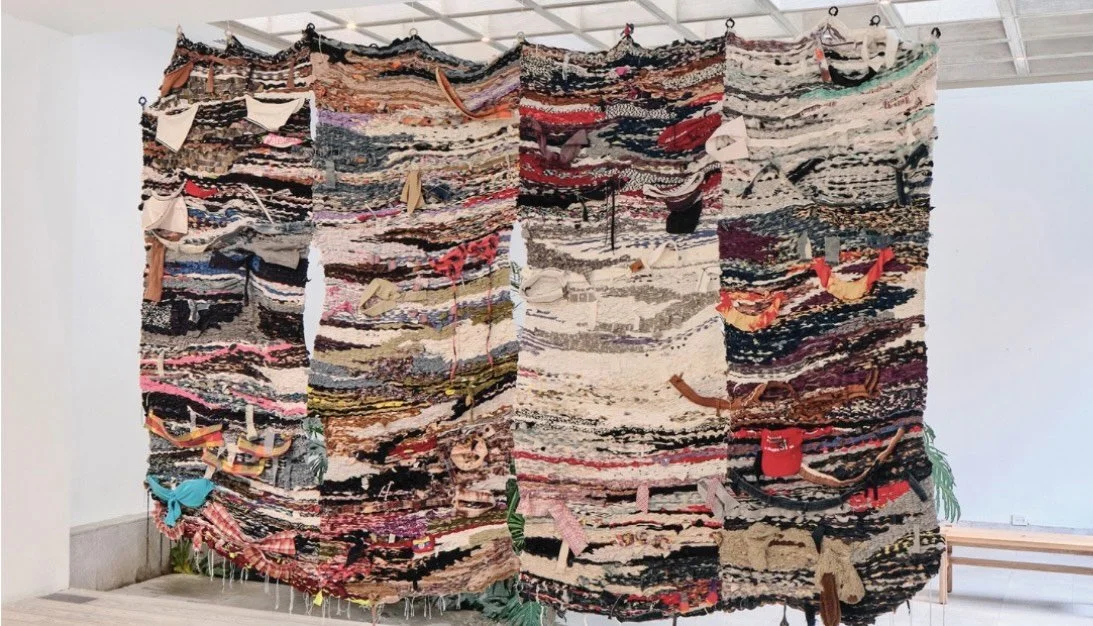
Cassandra Mayela Allen, Maps of Displacement NYC, 2021.
Mayela Allen came to weaving intuitively rather than by training (she studied graphic design) with her 2021 project Maps of Displacement, producing two spectacular hanging sculptures that have been featured in solo and group exhibitions in New York, Washington, D.C., and Mexico City. Her tapestries hold a commanding presence, heavy with waves of color that lure you into their knots and frays. Draw closer, and the fibers begin to speak; notice a jean belt loop, a string of buttons that lead to a shirt collar, a dangling bra. These are the clothes of Venezuelan migrants, each bearing a story of displacement, which Mayela Allen collected in an open call. She then cut them into strips and tied them one by one.
In 2014, Mayela Allen left Caracas for Brooklyn, becoming one of the nearly 8 million Venezuelans who have fled the economic and humanitarian crises unfolding under autocrat Nicolás Maduro (a displacement emergency on the scale of Ukraine’s and Syria’s yet often overlooked) [2]. Maps of Displacement calls for awareness while foregrounding the resilience of the Venezuelan people; it also speaks directly to a deeply fractured Venezuelan diaspora: “I feel that, regardless of your economic or migration status, we all hold onto clothes even when we’re not wearing them,” says the artist.
Mayela Allen is interested in how identities change through space, what they carry, and what gets replaced along the way. Her words, I told her, reminded me of the titular short story in The Things They Carried, by Tim O’Brien, a book about an American platoon in Vietnam I read in high school. She said her husband thought the same. But beyond Mayela Allen’s use of clothing, so personal yet universal, to record individual stories, what strikes me most about her work is its form of corporeality: how it gives body, not just visibility, to the intangibles of displacement (where has that baseball cap been, and can I touch it?). Her maps trace a shared human experience, not borders (says the artist, “The land is the land, right?”). Take a step back from the sculpture, and its voices join again in a tale of paths crossing, growing apart.
Mayela Allen now weaves with a brace on her right wrist, but for a while, weaving became too painful on her ligaments. Maps of Displacement also took an emotional toll. Mayela Allen was processing hundreds of heartbreaking donations/stories and was at the same time involved in aiding migrants newly arrived in New York. As a sanctuary city with restricted cooperation with Immigrations and Customs Enforcement (ICE), New York has received 225,000 migrants since 2022 [3]. The largest national group housed in the city’s shelters are Venezuelans [4].
Unable to weave and emotionally depleted, Mayela Allen dusted off her sewing machine. “It’s a little cheesy,” she said, “but I had this dream of covering myself with this, like, bodega quilt.” As with weaving, Mayela Allen made that first quilt without as much as a how-to video. “I feel so silly,” she told a friend, “I’m making a blanket, essentially.” Her friend helped her see the bodega quilt as her body’s response to burnout: “I was essentially just making this blanket of New York for myself, because I needed to feel held by it so I could hold it back.”
If Mayela Allen’s tapestries are maps, her quilts she describes as ethnographies; rather than weave people’s stories to construct a place (or lack thereof), they rely on (disappearing) places to bear witness to their community. “Looking Sharp” (2024) is a patchwork of hairstyles showcased through the windows of salons and barber shops. By celebrating the pleasures of self-care, Mayela Allen lends visibility simply in how people want to be seen. “I also love how bizarre these images are,” she added, referring to how sun exposure has left the pictures blueish, with something like a metallic taste that reveals the trace of time. “Health is Wealth” (2024), meanwhile, collages the white female bodies posted outside the beauty and massage parlors often run by and catering to women of color, so Mayela Allen stitches them onto a brown background.
According to the Association for Neighborhood and Housing Development, almost half (48 percent) of New York’s small businesses are immigrant-owned [5]. They are integral purveyors of jobs and affordable goods, yet many face landlord harassment and the majority struggle monthly to pay rising rents [6]. To this, Mayela Allen’s work again responds with its actively material presence. Quilts are tactile and strong; they give shelter. It’s as if Mayela Allen’s quilts preserve displaced spaces with something to hold on to. Also with good humor: in “Hall of Fame” (2024), warm fabrics frame a network of CCTV snapshots catching people stealing, all from a shop in Queens that pins them up with a caption of the item stolen. “It’s just hilarious,” says Mayela Allen, “New York can be so petty.” “But also like, props to people who, you know, kind of figure it out.” She continues, “Like, who should be ashamed, really? These people who just need a fucking nail clipper, or the system?”
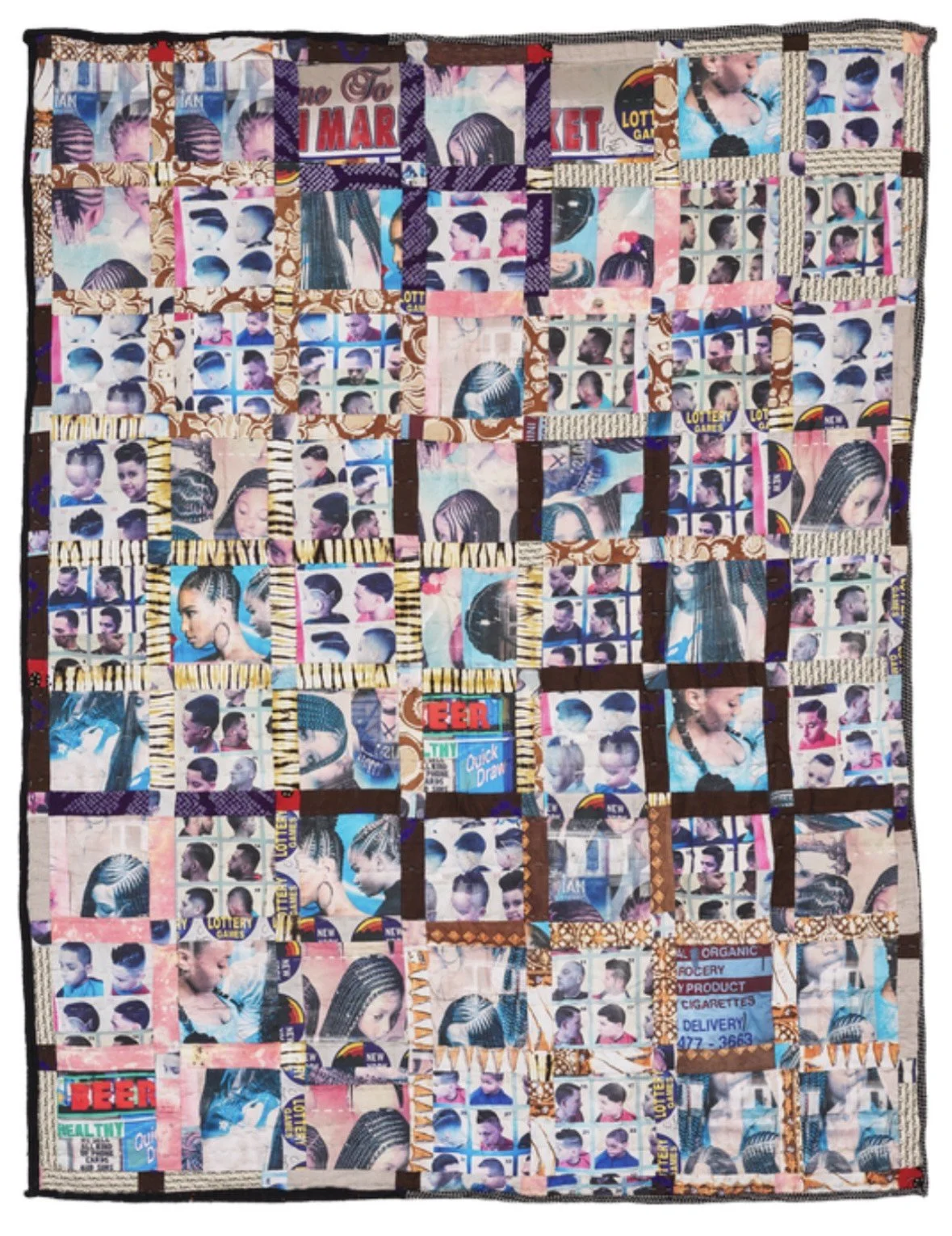
Cassandra Mayela Allen, Looking Sharp, 2023.
Quilts today are natural sites for feminist and civil rights protest, rooted in their evolution from women’s work to women’s forum [7]. In the 19th century, quilts called for the abolition of slavery and women’s rights, and they have since harbored the activist art of Ruth Clement Bond, Faith Ringold, Judy Chicago, Bisa Butler, and countless others [8]. Mayela Allen’s quilts follow suit. “The American dream is built on war, credit & debt / I want the anti-American dream / I want peace & abundance,” writes Mayela Allen in an inverted patchwork of bubble letters across her 2024 work “Peace and Abundance.” At the center of the quilt is the photo of an icebox with the word ABOLISH graffitied above the big blue sign for ICE. Donald Trump’s second presidency has deepened the strain on Mayela Allen’s tone of resilience, if also heightened the need for it. In January, Trump suspended asylum and ICE began conducting raids in New York [9]. In February, the administration rescinded $80 million in funds for New York’s shelters and revoked the temporary protected status of 300,000 Venezuelans [10]. The threat of deportation has kept halal trucks in garages, line cooks out of kitchens, and children out of schools [11]. They leave incomplete spaces behind.
“It’s saddening,” Mayela Allen said, returning to the whitewashing of bodegas, “because a place loses its identity. But the place is losing its identity because the people are being displaced.” To Mayela Allen, places and people are intertwined: it’s the community that gives spaces their singularity, just as people lose part of themselves when forced to leave a place.
Woven somewhere into one of Mayela Allen’s sculptures is a hot red bikini thong, donated to Maps of Displacement by a friend of hers, who realized she had not worn it in seven years, since her family’s last vacation in Venezuela. She wouldn’t wear something so small on a U.S. beach. Now it’s a crumb along the path of displacement, which Cassandra Mayela Allen has picked up and tenderly preserved. She’s also recollecting what’s been gained, the flavors and styles, textures and words. She wants to wrap it all under her quilt.
[1] The number 13,000 bodegas estimate from the United Bodegas of America (UBA): https://unitedbodegasofamerica.net/nuestra-historia/ This number is frequently cited, for example,
Hansi Lo Wang, “New York City Bodegas And The Generations Who Love Them,” NPR, March 10, 2017, https://www.npr.org/sections/codeswitch/2017/03/10/518376170/new-york-city-bodegas-and-the-generations-who-love-them and Emmal Orlow, “New York is in a Golden Age of Bodega Food,” Eater, 29 August, 2023. For more background on bodegas, see Pierina Pighi Bel, “Bodegas: The small corner shops that run NYC,” BBC, 5 October 2023, https://www.bbc.com/travel/article/20231005-bodegas-the-small-corner-shops-that-run-nyc This source cites a more conservative estimate on the number of bodegas in New York (7,000).
[2] “Venezuela Crisis Explained,” USA for UNHRC, April 17, 2024, https://www.unrefugees.org/news/venezuela-crisis-explained/ Betilde Muñoz-Pogossian and Alexandra Qinkler, “The Persistence of the Venezuelan Migrant and Refugee Crisis,” November 27, 2023, https://www.csis.org/analysis/persistence-venezuelan-migrant-and-refugee-crisis
[3] Luis Ferré-Sadurní and Jonah E. Bromwich, “N.Y. Migrants Fear Expulsion after Trump Expands Deportation Targets,” The New York Times, January 24, 2025, https://www.nytimes.com/2025/01/24/nyregion/nyc-migrant-shelter-deportation.html?searchResultPosition=3
[4] Luis Ferré-Sadurní, “8 Months Inside New York’s Migrant Shelters: Fear, Joy and Hope,” The New York Times, December 23, 2024, https://www.nytimes.com/2024/12/23/nyregion/nyc-migrant-shelters.html
[5] This number is from 2019. Lena Afridi and Diana Drogaris, “The Forgotten tenants: New York City’s Immigrant Small Business Owners,” The Association for Neighborhood and Housing Development, June 3, 2019 https://anhd.org/report/forgotten-tenants-new-york-citys-immigrant-small-business-owners
[6] Lena Afridi and Diana Drogaris, “The Forgotten tenants: New York City’s Immigrant Small Business Owners,” The Association for Neighborhood and Housing Development, June 3, 2019, https://anhd.org/report/forgotten-tenants-new-york-citys-immigrant-small-business-owners
[7] Whitney Chadwick, Women, Art, and Society, (London: Thames and Hudson, 2020), 212; Sarah Rose Sharp, “The Subversive Power of Quilting,” Hyperallergic, December 21, 2020. https://hyperallergic.com/608086/radical-traditions-american-quilts-toledo-museum/
[8] Whitney Chadwick, Women, Art, and Society, (London: Thames and Hudson, 2020), 212, 213; Angelik Vizcarrondo-Laboy, “Fabric of Change: The Quilt Art of Ruth Clement Bond,” Museum of Arts and Design, February 22, 2017, https://madmuseum.org/views/fabric-change-quilt-art-ruth-clement-bond ; Chad Scott, “Quilts as Activism Explored in ‘Radical Tradition’ At Toledo Museum of Art,” Forbes, November 28, 2020, https://www.forbes.com/sites/chaddscott/2020/11/28/quilts-as-activism-explored-in-radical-tradition-at-toledo-museum-of-art/ Joshua Needleman, “Hip-Hop’s Next Takeover: Quilts,” The New York Times, ay 15, 2023. https://www.nytimes.com/2023/05/15/special-series/quilting-textiles-bisa-butler.html
[9] Sergio Martínez-Beltrán, “President Trump’s suspension of asylum marks a break from U.S. past,” NPR, January 23, 2025, https://www.npr.org/2025/01/23/nx-s1-5272406/trump-suspends-asylum ; Luis Ferré-Sadurní and Chelsia Rose Marcius, “Federal Immigration Enforcement Begins in New York with Much Fanfare,” The New York Times, January 28, 2025 https://www.nytimes.com/2025/01/28/nyregion/ice-raid-nyc-noem.html?searchResultPosition=1
[10] Hamed Aleaziz and Maggie Haberman, “Trump Administration Moves to End Protections for Venezuelans in the U.S.,” The New York Times, February 2, 2025 https://www.nytimes.com/2025/02/02/us/politics/trump-venezuela-temporary-protected-status.html Luis Ferré-Sadurní, “New York Got $80 Million For Migrants. The White House Took it Back.” The New York Times, February 12, 2025 https://www.nytimes.com/2025/02/12/nyregion/doge-migrant-hotel-shelters.html?searchResultPosition=5
[11] Chris Crowley, “ICE Has Restaurant Workers Terrified” New York Magazine, February 4, 2025. https://www.grubstreet.com/article/nyc-restaurants-ice-raid-stories.html?itm_medium=site&itm_source=order-form&_gl=1*2l2nia*FPAU*Njc2MjgxNjU0LjE3Mzk5Njk2OTQ.*_ga*MjkyMjQ0NDk5LjE3MzM5MzIwNDc.*_ga_DNE38RK1HX*MTc0MDM0ODI5Ny40LjEuMTc0MDM0ODQ3Ni4wLjAuMTMwNTUzMzQ2OQ..*_fplc*Z1JNSHc2Qjl5WVM1ckpneDVZS1hNd0NlcFRCOEV4VHBhU3MlMkZSR0oxZHh6JTJCNXYyczd0eGlIc1dzOUFZd2t6Qmw1ZEdYZUptc0w2TVFEeHRDJTJCdExyYmEwaXhIUnh6UDlMdlI0VnpwNWhPTmh1SzFFJTJGMHQlMkZKJTJGRXlEQjAlMkI4WWclM0QlM0Q ; Haidee Chu, “Migrant Vendors Park Carts and their American Dreams Slip Away,” The City, January 30, 2025. https://www.thecity.nyc/2025/01/30/migrant-vendors-trump-deporations-arrests-immigrants-fears/ ; Michael Elsen Rooney, “Deportation Fears Keep Migrant Kids out of School as ‘Everyone is Scared’,” The City, January 24, 2025. https://www.thecity.nyc/2025/01/24/migrant-students-parents-deportation-trump-fears-nyc-schools/